
AI Isn't the Problem. Unstructured Use is.
- Jeff Uhlich

- Mar 22
- 5 min read

If you’re running an Alberta small business or nonprofit organization with 2 to 10 employees, the biggest mistake right now isn’t doing too little with AI. It’s using it randomly, between everything else you’re carrying.
For the last year, the loud question has been: “Should we use AI?” That question’s basically over. Adoption is already happening, but it’s shallow, messy, and starting to create real risk.
The harder question is: “How do we use it safely, without burning time, budget, or trust?” If you’re feeling AI fatigue, you’re not behind. You’re noticing the gap between hype and the reality of a messy spreadsheet that won’t format correctly.
The Shift From "If" to "How"
The "if" phase was about experimentation. It was about playing with ChatGPT to write a LinkedIn post or a funny poem for a retirement party. But for Alberta small businesses and nonprofits, the novelty’s worn off.
Recent ICTC data highlights a widening gap. Larger firms are compounding their advantage by integrating AI into their core operations. Meanwhile, many small businesses are stuck in a cycle of avoidance or ad hoc use.
Why? Because the cost of entry feels high, the skills aren't there, and the ROI is about as clear as a prairie blizzard. But here’s the truth: you don't need a massive transformation programme. You need a way to solve specific problems without breaking your data privacy or your budget.
The Danger of "Shadow AI"
There’s a risk growing inside your organisation. It’s called Shadow AI. This happens when your staff use public AI tools to complete work tasks without any policy, training, or oversight.

Here’s the uncomfortable part: you can’t manage what you can’t see. AI adoption is often individual-driven rather than organisation-led. Innovative and future forward members of your team can champion the use of new tools - with or without your explicit approval. And if they sense resistance, that might drive use of these tools underground. Your team is likely using these tools right now to summarise meeting notes, write emails, or even analyse sensitive financial data.
If they’re using free, public versions, you may be pushing company data into places you can’t control. Even when a tool says it “doesn’t train on your data”, your risk is still real: copy and paste is a data transfer.
This isn’t just an IT problem, it’s a leadership problem. If there’s no clear rule set, people will make up their own. That’s Shadow AI.
Non-profits: High Usage, Low Maturity
The situation’s even more acute in the non-profit sector. Reports suggest that up to 80% of non-profits are using AI in some capacity. However, less than half have any formal policy in place.
Most non-profits use AI for communication and fundraising. While this saves time, it can create a massive reputational risk. Imagine an AI-generated donor letter that hallucinates facts about your impact, or a chatbot that gives incorrect advice to a vulnerable client.
For community-facing organisations in Alberta, trust is the primary currency. One high-profile mistake can erode years of hard work. The demand for "safe AI" isn't just a trend: it’s a requirement for survival in a world where public scrutiny’s at an all-time high.
The "Small Wins" Approach to ROI
The era of vague experimentation is over. ROI pressure is rising faster than technical capability. The market filter has changed to a simple demand: "Show me value in 30 to 90 days or we stop."

At augmentus inc., we call this the “Small Wins” approach. It’s not about building an AI strategy deck. It’s about getting a measurable return in 30 to 90 days, with boring, practical improvements.
Instead of trying to AI-enable your whole company, pick one workflow that’s already costing you hours. Customer onboarding. Invoicing. Quote follow-ups. Hiring paperwork.
Fix it, secure it, prove it, then measure the time saved.
The augmentus check: if you got two to three hours back per week, per person, what would you do with that time? If you can’t measure a real gain, it’s a hobby, not a business decision.
The Myth of Structured Data
One of the biggest hurdles to implementation is the state of your data. Most people think they need a perfect database before they can start.
The reality is that 80% of your business intelligence is trapped in unstructured formats: emails, PDFs, call transcripts, and contracts. AI models can’t automatically connect an unstructured document to a structured database without a deliberate process.
IBM estimates that only 1% of enterprise unstructured data’s actually accounted for in large language models. That means most organisations are failing to leverage their most valuable information - organizational context. But this needs to be managed securely.
The organisations that win won't be the ones with the most expensive software. They’ll be the ones that learn how to govern and connect their messy, real-world data to their AI applications safely. This is where an AI readiness assessment becomes invaluable. At a high level - do you understand your technical, cultural, and employee readiness? Do you understand how these three domains intersect to make or break your adoption of AI?
The Skills Gap is the Real Bottleneck
You don't have a tool problem. You have a skills gap. Tools are easy to buy: knowing what to do with them is the hard part.
In Western Canada, smaller labour pools mean we can’t simply hire our way out of this. We have to train our way out. AI training for staff shouldn't be about generic "AI literacy." It should be tied to real work.
Your team needs to understand the Human-In-The-Loop protocol. The process is simple:
Input (Human provides context)
AI (The tool generates a draft)
Human Review (The critical step)
Output (The final result)
Verify (Accountability stays with the human, every time)
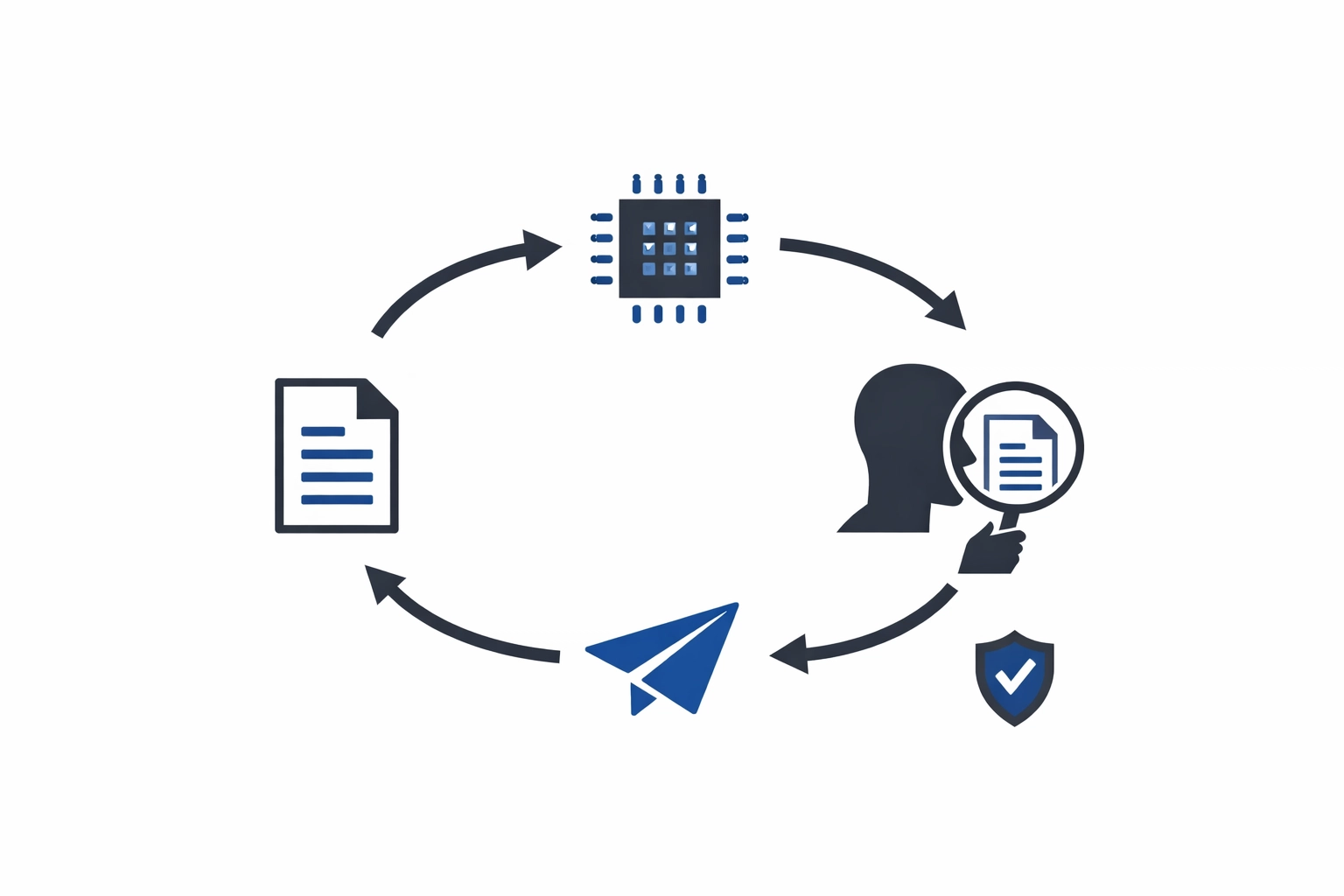
If anyone in your company thinks AI output is “good enough” without review, that’s not efficiency, it’s risk.
Funding and Ecosystem Support
There’s good news for Alberta businesses. Funding and ecosystem support’s increasing. Organisations like PrairiesCan and initiatives like the RAII are investing heavily in applied AI.
The money’s there, but project clarity is often missing. Funding agencies don't want to see more tools: they want to see defined use cases and implementation support. They want to see how you’re solving regional problems in sectors like construction, agriculture, and professional services.
We aren't looking for more hype. We’re looking for workflows that work. We often point our clients toward ecosystem navigators like Amii or Alberta Innovates to help bridge the technical gap. Our $ For SMBs page has a handy questionnaire you can use to answer a few quick questions to get funding sources that are a best fit for your organization.
The augmentus Protocol: A Careful Approach
If you’re a resource-constrained owner or a nonprofit leader, your anxiety’s valid. The "Jagged Edge" of AI means it’s incredibly competent at some tasks and spectacularly wrong at others.
Our approach at augmentus inc. is built on a "Healthy Distrust." We don't want you to become an AI evangelist. We want you to become a strategic skeptic.
Ask yourself:
Where are my staff using AI today, without telling me?
Which one workflow, if improved, would change my week within 90 days?
If I asked a new hire, could they tell me what data must never go into public AI tools?
Those answers tell you whether you have AI “usage”, or you have AI leadership.
Moving Forward: Focus on One Safe Workflow
Don’t let the complexity paralyse you. Here’s what’s true on the ground: adoption’s happening, value is inconsistent, and governance is missing. That’s the messy middle, and it’s fixable.
Your edge isn’t becoming an AI expert. Your edge is making AI safe, useful, and worth the effort within a 90-day window.
Stop trying to build a five-year strategy. Build a 30-day pilot. Pick one workflow, set basic rules for data and review, then verify the results.
If you’re ready to move past random tool use and start building a structured, safe implementation, let’s talk. We offer a free introductory workshop to identify your first high-ROI workflow.
One direct question before you scroll: what’s the first workflow you’re willing to standardise, so Shadow AI stops being a surprise?
Comments