
This is the first edition of our monthly Alberta AI Brief, written for small organizations that don’t have spare staff, large budgets, or patience for technology theatre.
The headline is attention-grabbing: Statistics Canada reports that AI use among Canadian businesses rose from 6.1% in the second quarter of 2024 to 19.2% in the year leading into the second quarter of 2026. That’s more than a tripling of reported use.
But there’s a second number worth taking seriously: 40% of businesses said AI isn’t relevant to them.
Both figures can be true. AI adoption is growing quickly, while many owners and nonprofit leaders still can’t see a sensible connection to the work they do every day.
Here are five signals Alberta organizations should watch.
1. AI adoption is moving from basic training to practical implementation
In late July, OpenAI launched a ChatGPT for Small Business programme built around hands-on training, ready-made workflows, guides, and integrations.
That matters because the question is changing.
It used to be:
“How do we teach people to write better prompts?”
Now it’s:
“Which repetitive job should we improve, and how do we make it safe and repeatable?”
For a small Alberta business, that could mean customer follow-up lists, review summaries, or a cash-flow briefing. For a nonprofit, it might mean grant files, board materials, policy summaries, or less time digging through old documents.
The opportunity isn’t generic AI literacy. It’s helping an organisation choose one useful workflow, set it up properly, and keep a person accountable for the result.
That’s the difference between AI consulting Alberta and simply showing someone where the chatbot button is.
The trap: basic “how to use ChatGPT” training will get harder to differentiate. AI implementation services, workflow design, review rules, and measurement are the stronger services.
2. Microsoft is testing a structured 30-day adoption model
Microsoft’s Copilot in 30 programme gives eligible organizations with fewer than 300 employees access to a 25-user, 30-day trial of Microsoft 365 Copilot Business through Cloud Solution Provider partners.
The useful part isn’t the trial itself. It’s the structure:
- Identify priority use cases.
- Select a small group of users.
- Experiment with real work.
- Measure the value.
- Decide whether to scale.
That is a sensible model for almost any small organisation.
A trial should not begin with, “Let’s give everyone access and see what happens.” That usually creates scattered experiments and a bill that’s hard to justify later.
A practical AI strategy for small business should answer three questions:
- What work are we improving?
- How much time does it take now?
- What result would justify keeping the new process?
If the pilot doesn’t produce a measurable improvement within 30 days, stop or change direction. “Everyone enjoyed experimenting” is not a return on investment.
3. The 40% who say AI isn’t relevant may be asking the right question
Statistics Canada’s adoption figures show that AI is becoming more common. They do not show that every organisation should adopt it.
Forty percent of businesses still said AI was not relevant to their operations. For many of them, that may be a reasonable conclusion. A small construction company, community association, or professional practice does not need AI because other organisations are using it.
It needs AI only if a specific problem justifies the effort.
Start with the work, not the tool:
- Are customer enquiries sitting unanswered?
- Is follow-up happening too late?
- Are staff rewriting the same documents?
- Is important knowledge buried in inboxes and folders?
- Are volunteers spending hours preparing routine reports?
- Is the owner losing half a day each week to administration?
If the answer is no, you may not need an AI project right now.
If the answer is yes, an AI readiness assessment can help identify where a low-cost tool might assist, and where it would only add complexity.
This problem-first approach protects organisations from a common mistake: automating a poor process. If the inputs are incomplete, the instructions are unclear, and nobody checks the result, AI can produce a faster version of the wrong work.
4. Privacy and transparency are becoming part of normal AI operations
Canadian policy is moving towards clearer expectations around AI transparency.
The federal AI transparency consultation is open until September 23, 2026. Topics include identifying AI-generated content, notifying people when they’re interacting with AI, and explaining system capabilities and limitations.
Bill C-36, proposed federal privacy legislation, would also modernise privacy requirements and increase transparency around automated decision-making. It is proposed legislation, not a current set of obligations.
Alberta organizations should not wait for every policy detail to be final before acting responsibly. Alberta’s Personal Information Protection Act already applies when covered organisations collect, use, disclose, or store personal information.
At minimum, an organization should know:
- Which AI tools staff are using
- What information is entered into each tool
- Who reviews AI-generated work
- When customers, clients, donors, or volunteers should be told AI is involved
- What happens when an AI output is wrong
A useful AI governance framework doesn’t need to be a 40-page document. For a very small organisation, one or two pages may be enough.
Use this basic workflow:
Input → AI → Human Review → Output
The AI can draft, summarise, classify, or suggest. The human decides whether the result is accurate, appropriate, and safe to use. Accountability stays with the human.
5. Alberta nonprofits may have a funding route for capacity building
The Community Initiatives Program Organizational Development and Collaboration Grant offers up to $50,000 for individual nonprofit organizations and up to $100,000 for collaborative projects.
The next listed deadline is October 15, 2026.
This isn’t a promise that Alberta will fund a subscription to ChatGPT.
The stronger case is a capacity-building project involving knowledge management, volunteer coordination, workflow modernisation, AI training for staff, policy development, or better grant and reporting processes.
AI could be one part of that project, alongside process mapping, document organisation, training, and governance.
A nonprofit should confirm eligible costs and project fit directly with the programme before preparing an application.
What Alberta organizations should do next
Here’s a practical starting list.
1. Pick one boring, expensive workflow
Choose a task that happens often and consumes real time. Avoid high-stakes decisions in an initial pilot.
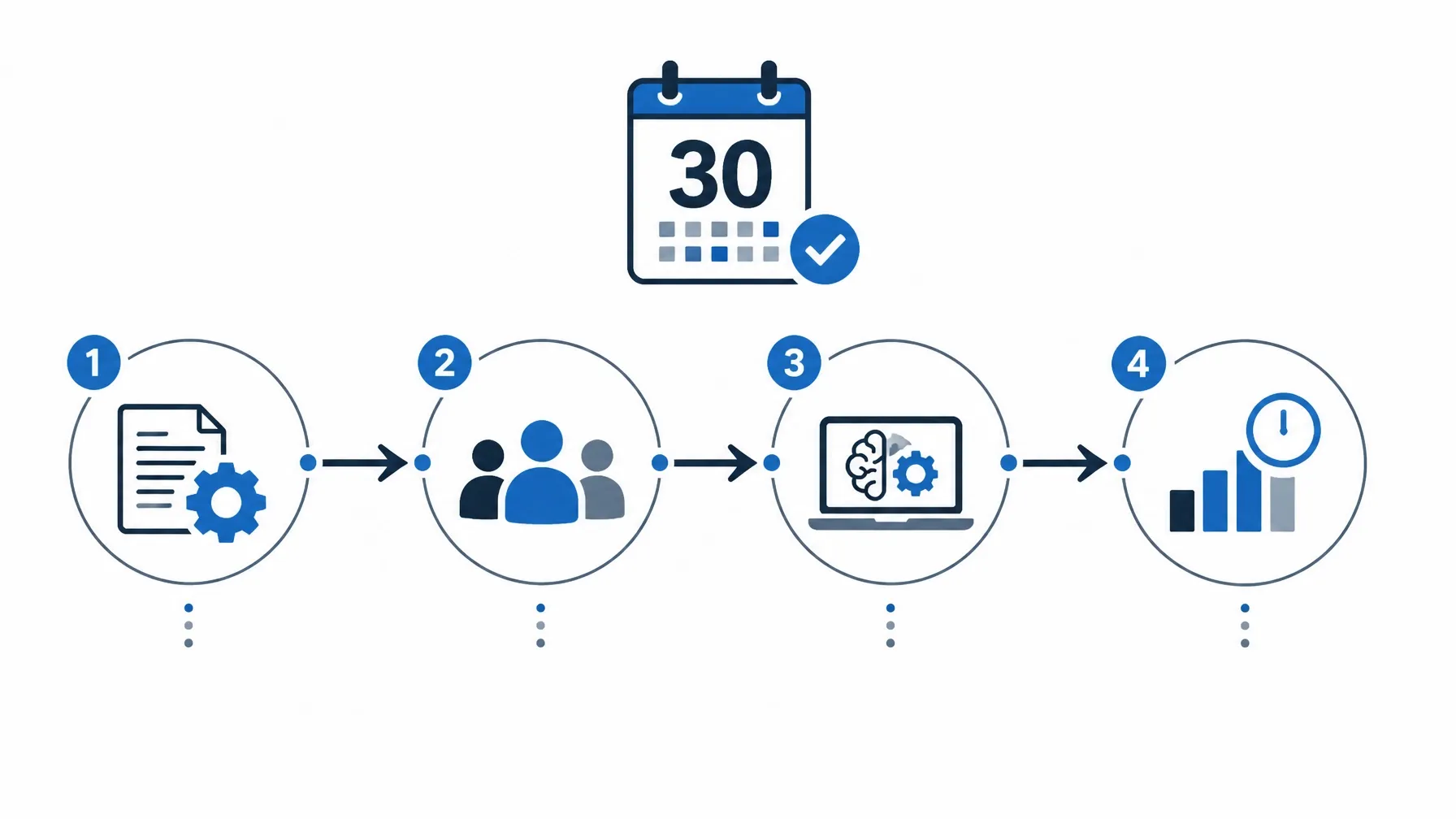
2. Run a 30-day pilot
Use the structured sequence:
- Step 1: Discover: define the task, inputs, risks, and current time cost.
- Step 2: Plan: choose the tool, write the workflow, and set a baseline.
- Step 3: Improve: build a small working version with real examples.
- Step 4: Implement and Train: test it with the people who will use it.
- Step 5: Verify: check accuracy, privacy, usefulness, and time saved before accepting any recommendation, output, or publication.
Step 5 is the final gate. If the result isn’t good enough, it doesn’t go forward.
3. Write a one-page AI use policy
List approved tools, restricted information, human-review rules, disclosure expectations, and who remains accountable.
4. Check the CIP deadline
If you’re a nonprofit considering organizational capacity work, review the CIP grant details and confirm eligibility before investing time in an application.
The augmentus take
AI implementation for ordinary small organizations is becoming a recognizable product category.
That doesn’t mean every owner needs a chatbot, an agent, or a stack of subscriptions. It means the useful work is getting clearer.
The opportunity is to be the local, trusted operator who:
- Identifies the right problem
- Installs the simplest workable solution
- Includes practical guardrails
- Trains the people using it
- Verifies whether it saved time or money
Our position is simple:
We help small organizations eliminate repetitive work using AI tools they can actually afford and manage themselves.
That may involve business process automation AI, document workflows, customer support, reporting, internal knowledge management, or targeted AI implementation services. It may also conclude that AI is not the right answer.
If you’re unsure where to begin, book a free initial consultation with augmentus. We’ll start with the work, not the hype.
The uncomfortable question is this: what repetitive task will your organization still be doing manually 90 days from now, even though you already know it’s costing you time?